
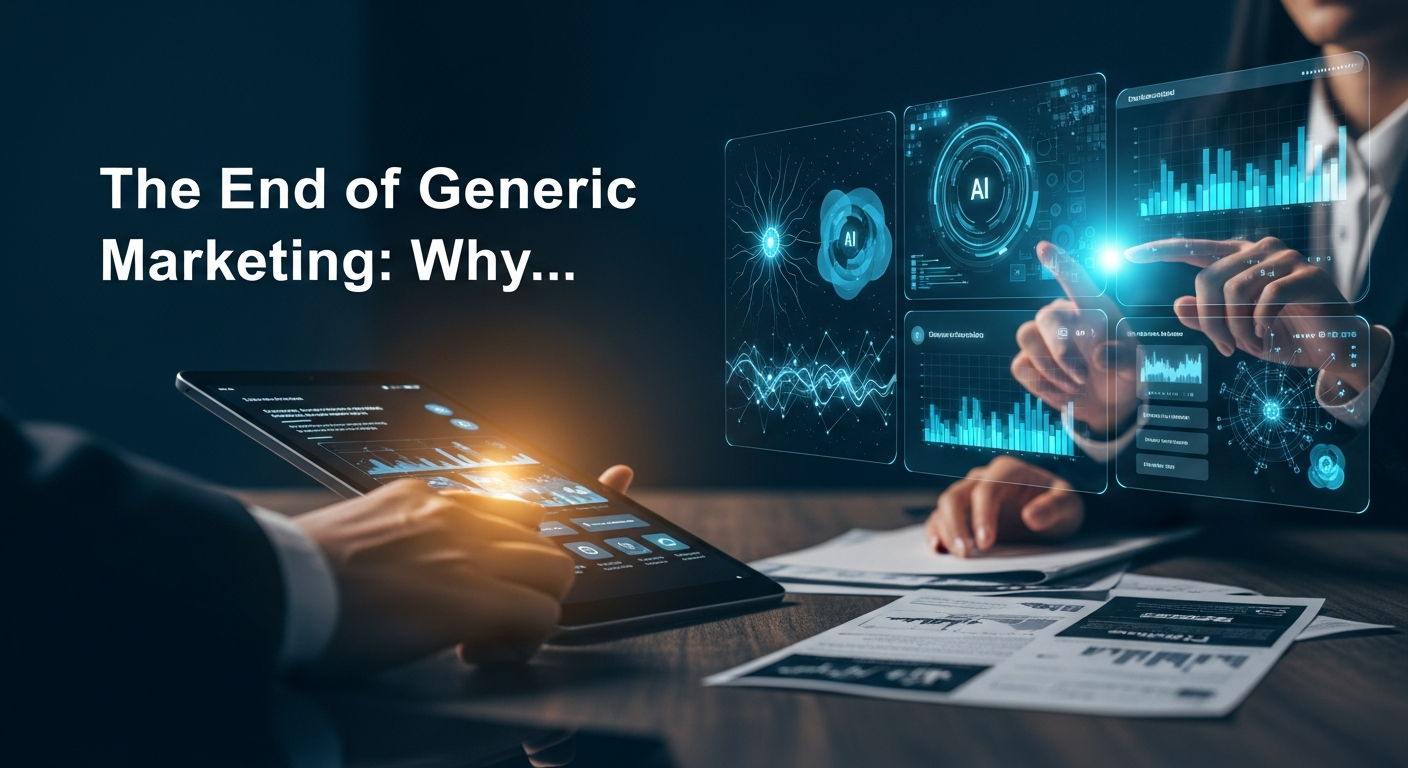
The End of Generic Marketing: Why Hyper-Personalization via AI is Non-Negotiable for 7-Figure Growth
The End of Generic Marketing: Why Hyper-Personalization via AI is Non-Negotiable for 7-Figure Growth
In a world saturated with information and choices, the era of one-size-fits-all marketing has unequivocally drawn to a close. Consumers today, particularly in the rapidly evolving Indian market, expect more than just a product or service; they demand a tailored experience that speaks directly to their individual needs, preferences, and even their emotional state. For businesses aspiring to achieve and sustain 7-figure growth, embracing this shift is not merely an option—it is an existential imperative. At Talkbeyond.blog, we believe that hyper-personalization, powered by advanced Artificial Intelligence (AI), is the ultimate differentiator and the strategic bedrock for exponential business development.
Gone are the days when broad demographic segmentation yielded significant returns. Today's market leaders understand that true engagement stems from deep, individualized relevance. This post will delve into how AI-driven hyper-personalization is transforming marketing, automation, and overall business strategy, making it a non-negotiable component for any enterprise targeting formidable growth.
The Shifting Sands of Customer Expectations
Modern consumers are digitally native and incredibly discerning. They leave a vast trail of data—from browsing history and purchase patterns to social media interactions and customer service queries. The challenge for businesses isn't a lack of data, but rather the inability to process and derive actionable insights from this deluge at scale. Without AI, the sheer volume of information makes it impossible to craft truly individual experiences.
- Patience is Scarce: Consumers expect instant gratification and relevant information without sifting through noise.
- Loyalty is Earned: Brand loyalty is no longer a given; it's cultivated through consistent, positive, and personalized interactions.
- Privacy & Trust: While demanding personalization, customers also expect businesses to handle their data responsibly and transparently.
This dynamic landscape demands a proactive approach, where businesses anticipate customer needs and deliver bespoke experiences before being asked. This is precisely where AI-driven hyper-personalization steps in.
What is Hyper-Personalization, and How Does AI Drive It?
While traditional personalization might suggest addressing a customer by name in an email or recommending products based on past purchases, hyper-personalization takes this to an entirely new dimension. It’s the real-time, dynamic tailoring of every touchpoint in the customer journey based on a comprehensive, continuously updated profile of an individual's behavior, preferences, context, and intent. AI is the engine that makes this level of precision possible.
AI-Powered Data Synthesis
AI algorithms excel at processing vast, disparate datasets at speeds unimaginable for human analysis. They can ingest everything from transactional records, browsing history, geographic location, device usage, social media sentiment, and even micro-moment interactions. Machine learning models then identify complex patterns, correlations, and predictive indicators that reveal a customer's true intent and evolving needs.
Predictive Analytics for Proactive Engagement
Beyond understanding past behavior, AI empowers businesses with predictive capabilities. It can forecast future actions, identify potential churn risks, predict the next best product recommendation, or even determine the optimal time and channel for communication. This allows businesses to move from reactive marketing to proactive engagement, intercepting customers with precisely what they need, exactly when they need it.
Unleashing 7-Figure Growth: AI in Action Across the Business Lifecycle
The strategic deployment of AI for hyper-personalization translates directly into tangible business outcomes, driving revenue growth across various stages.
Enhanced Customer Acquisition: From Prospects to Loyal Advocates
AI refines customer acquisition by ensuring marketing spend is directed towards the most promising prospects. For instance, advanced advertising platforms leverage AI to dynamically optimize ad creatives, bidding strategies, and audience targeting in real-time, ensuring that ads resonate deeply with specific micro-segments. Leading e-commerce platforms, whether global giants or flourishing Indian startups, utilize AI to personalize landing pages and product displays even for first-time visitors, drastically improving conversion rates.
Supercharged Customer Engagement & Retention
Once acquired, AI becomes instrumental in fostering long-term relationships. Consider how streaming services recommend content with uncanny accuracy, or how financial institutions offer personalized investment advice based on individual risk profiles and financial goals. AI-powered chatbots provide instant, intelligent support, resolving queries and even guiding users through complex processes, significantly enhancing customer satisfaction and reducing operational costs. This leads to higher customer lifetime value (CLV).
Optimized Sales Funnels and Revenue Generation
For B2B companies, AI can score leads with unprecedented accuracy, ensuring sales teams focus on high-potential prospects. Dynamic pricing models, powered by machine learning, can adjust product prices in real-time based on demand, inventory, competitor pricing, and individual customer profiles, maximizing profit margins. Cross-selling and up-selling become far more effective when AI identifies complementary products or services that a customer is highly likely to need or desire, leading to increased average order value.
Operational Efficiency & Resource Optimization
Beyond direct revenue, AI-driven hyper-personalization significantly improves operational efficiency. Marketing automation platforms, infused with AI, streamline campaign management, segment audiences automatically, and optimize delivery schedules. This reduces manual effort, minimizes wasted ad spend, and allows marketing teams to focus on strategic initiatives rather than repetitive tasks. The result is a leaner, more agile, and more effective marketing operation.
The Indian Context: A Market Ripe for AI-Driven Personalization
India, with its vast and diverse digital population, presents a unique and fertile ground for AI-driven hyper-personalization. The rapid adoption of smartphones, increasing internet penetration, and the burgeoning digital economy mean that Indian consumers are increasingly comfortable with and expect highly tailored digital experiences. Businesses that fail to adapt risk being left behind in a fiercely competitive landscape. From Tier-1 cities to emerging Tier-2 and Tier-3 markets, the demand for relevant, individualized content is universal. Talkbeyond.blog stands as a critical resource for Indian businesses navigating this complex, yet opportunity-rich, terrain.
Implementing AI-Driven Hyper-Personalization: A Strategic Roadmap
Embarking on this journey requires a strategic approach, not just a technological one.
Data as the New Gold
The foundation of effective hyper-personalization is robust data. Businesses must focus on collecting clean, relevant, and comprehensive customer data from all touchpoints, ensuring its integrity and accessibility.
Starting Small, Scaling Big
Instead of attempting a massive overhaul, begin with pilot projects in specific areas, such as email marketing personalization or website recommendations. Learn from these initial implementations, iterate, and then scale successful strategies across the organization. This iterative approach minimizes risk and builds internal expertise.
- Invest in Talent: Develop internal AI capabilities or partner with specialized firms.
- Ethical AI: Prioritize data privacy, security, and ethical considerations to build customer trust.
- Continuous Optimization: AI models require constant training and refinement based on new data and changing customer behaviors.
Conclusion
The trajectory towards 7-figure growth for businesses today is inextricably linked to their ability to deliver hyper-personalized experiences. Generic marketing is not just inefficient; it's a liability in an age where customers expect to be understood and valued individually. AI is no longer a futuristic concept but a present-day necessity, driving unparalleled insights, automation, and competitive advantage. By embracing AI-driven hyper-personalization, businesses can unlock new levels of customer engagement, loyalty, and revenue, paving the way for sustainable and significant expansion.
At Talkbeyond.blog, we empower business leaders with the knowledge and strategies to harness these transformative technologies. Join our community to stay at the forefront of AI, marketing automation, and business development.
Frequently Asked Questions (FAQ)
Q1: What is the primary difference between personalization and hyper-personalization?
While both aim to tailor experiences, personalization typically uses broad segments (e.g., demographics, general interests) to offer somewhat relevant content. Hyper-personalization, powered by AI and machine learning, goes much deeper by leveraging real-time, individual-level behavioral data, predictive analytics, and contextual cues to deliver highly specific, dynamic, and adaptive experiences at every touchpoint. It's about tailoring content not just to a segment, but to an individual's current state and anticipated future needs.
Q2: How can SMEs in India implement AI-driven hyper-personalization without a massive budget?
SMEs can start with affordable, cloud-based AI tools and platforms designed for marketing automation and customer relationship management (CRM) that integrate basic AI features. Focus on specific, high-impact areas first, like personalized email campaigns, dynamic website content using simple recommendation engines, or AI-powered chatbots for initial customer support. Leverage existing data and look for 'low-code/no-code' AI solutions to minimize development costs. Partnering with a specialized digital agency can also provide access to expertise without significant in-house investment.
Q3: What are the biggest challenges in deploying AI for hyper-personalization, and how can they be overcome?
Key challenges include data silos, poor data quality, lack of skilled talent, and ethical concerns around data privacy. Overcoming these requires a strategic approach: breaking down data silos by integrating systems, investing in data governance and cleansing processes, upskilling existing teams or hiring AI specialists, and implementing robust privacy policies compliant with regulations. Starting with pilot projects and demonstrating tangible ROI can also help secure internal buy-in and resources for broader deployment.
Q4: How does AI hyper-personalization directly contribute to 7-figure revenue growth?
AI hyper-personalization drives 7-figure revenue growth by: 1) increasing customer acquisition through more effective, targeted campaigns and higher conversion rates; 2) boosting customer retention and loyalty, which directly translates to higher Customer Lifetime Value (CLV); 3) optimizing sales funnels through intelligent lead scoring, dynamic pricing, and more effective cross-selling/up-selling opportunities; and 4) enhancing operational efficiency by automating marketing tasks and reducing wasteful spending, allowing resources to be reallocated to growth initiatives. These combined effects create a powerful flywheel for sustained, exponential revenue growth.
Ignite Your Growth Journey with Talkbeyond.blog
Don't let your business be left behind in the generic past. The future of 7-figure growth is hyper-personalized and AI-driven. Visit Talkbeyond.blog today for cutting-edge insights, strategies, and deep dives into how AI & ML, marketing automation, and business development can transform your enterprise. Subscribe to our newsletter to receive the latest thought leadership directly in your inbox, and share this article with your network to empower more businesses to embrace the power of AI.


COMMENTS
Loading comments...
Leave a Comment